

Last updated: Tuesday 29th September 2026
Most private schools don't have a visibility problem. They have a conversion problem. Families find the school, glance at the website, maybe book a tour, and then quietly choose somewhere else.
The private school marketing strategies that work in 2026 treat marketing and admissions as one journey. They run from the first Google or ChatGPT search to the day a family re-enrolls for another year. This guide sets out 12 of them, in roughly the order you'd put them into practice.
Each strategy includes what to do, what to avoid, and where we've seen it make a measurable difference for the schools we work with.
WHAT THIS ARTICLE COVERS:
- Set enrollment goals by grade and intake
- Research families and competitors properly
- Prove your positioning with outcomes, not adjectivess
- Turn your website into your best admissions officer
- Win local search
- Get found in AI
- Create content that helps families decide
- Point paid advertising at specific enrollment gaps
- Respond fast and nurture every inquiry
- Put reviews, referrals and ambassadors to work
- Treat retention as a school marketing channel
- Measure what leads to enrollment

1. Set enrollment goals by grade and intake
"Increase enrollment" isn't a goal a marketing plan can act on. "Fill 14 Year 7 places and 6 boarding places for September 2027" is. Specific targets tell you which families to reach, which messages to use, and how much you can afford to spend per enrollment.
Start with your capacity by grade, then work backwards through your own conversion rates:
- How many enrollments you need, by grade or program
- Your historic rates from inquiry to tour, tour to application, and application to enrollment
- The number of inquiries that implies, and by when
If you need 20 enrollments and one in five inquiries typically enrolls, you need roughly 100 qualified inquiries. That number, not website traffic, is what your marketing is for.
This also makes budget conversations with governors and heads much easier. You're asking for the cost of a known number of families, not "more marketing".
How to ask for a larger school marketing budget
2. Research families and competitors properly
Most independent schools describe their audience as "parents who value education". That describes every parent looking at every school. Useful research finds the specific worries, trade-offs, and triggers behind a decision to go private.
- Talk to your newest families.
Ask families who joined in the last two years why they chose you, which schools they also considered, and what nearly put them off. Ten short interviews usually tell you more than a large survey. - Talk to families who didn't join.
Admissions teams often know who toured and went elsewhere. A polite, brief follow-up call about why is the most valuable research most schools never do. - Build two or three personas from what you hear.
For younger children, parents usually decide alone. From around age 11, the child's opinion matters more, so messaging about friendships, activities, and belonging needs to speak to them directly. - Audit the school down the road.
Look at your nearest competitors' websites, fees, open event dates, social channels, and search ads. Note what they claim and, more usefully, what they don't. The gaps are where you can position.
3. Prove positioning with outcomes, not adjectives
Your unique selling proposition is the reason a family chooses you over the other independent schools nearby, and doing nothing. "Academic excellence", "a nurturing environment" and "small class sizes" don't do that job on their own, because nearly every private school says them.
The fix is to translate features into outcomes and back each one with proof:
|
schools claim |
Outcome families care about |
Proof that makes it believable |
|---|---|---|
|
Small class sizes |
Every child is known, and problems are caught early |
Average class size, and a teacher describing how they spot a struggling pupil |
|
Strong academics |
My child gets into the next school or university they want |
Destinations data and value-added results |
|
Wide co-curricular program |
My child finds something they love |
Participation rates and a student story |
|
Pastoral care |
My child is happy and safe |
Wellbeing approach, safeguarding information and a parent testimonial |
Pick two or three outcomes you can genuinely prove and make them the spine of every campaign, page and open event. Consistency matters more than cleverness. A family should hear the same promise on your website, in an ad and from the head at a tour.
Avoid promising specific results you can't control, such as a guaranteed university place.
4. Turn your school website into your best admissions officer
Your website is where families check whether what they heard is true. Most will visit it several times before they ever contact you, so it needs to answer their questions without making them ask.
The pages that matter most to prospective families are usually:
- Admissions:
The process, key dates and deadlines, step by step - Fees and financial support:
Clear figures, what's included, and bursary or scholarship routes. Hiding fees doesn't stop families caring about them; it just sends them to a third-party website or worse, a school that's upfront. - Each stage or program:
What a day looks like, what's taught, and who teaches it - Visit:
Open events, private tours, and virtual options, bookable in two clicks - Wellbeing and safeguarding:
How you keep children safe and happy, a top concern for parents
On every page, make the next step obvious. "Book a tour" and "Request a prospectus" should be visible on mobile without scrolling. Keep inquiry forms short: name, email, child's age or entry year, and an optional question. Every extra field costs inquiries.
Finally, test the site on a mid-range phone on a 4G connection. That's how most parents will first see it, often in the evening, often in a hurry.
5. Win local search
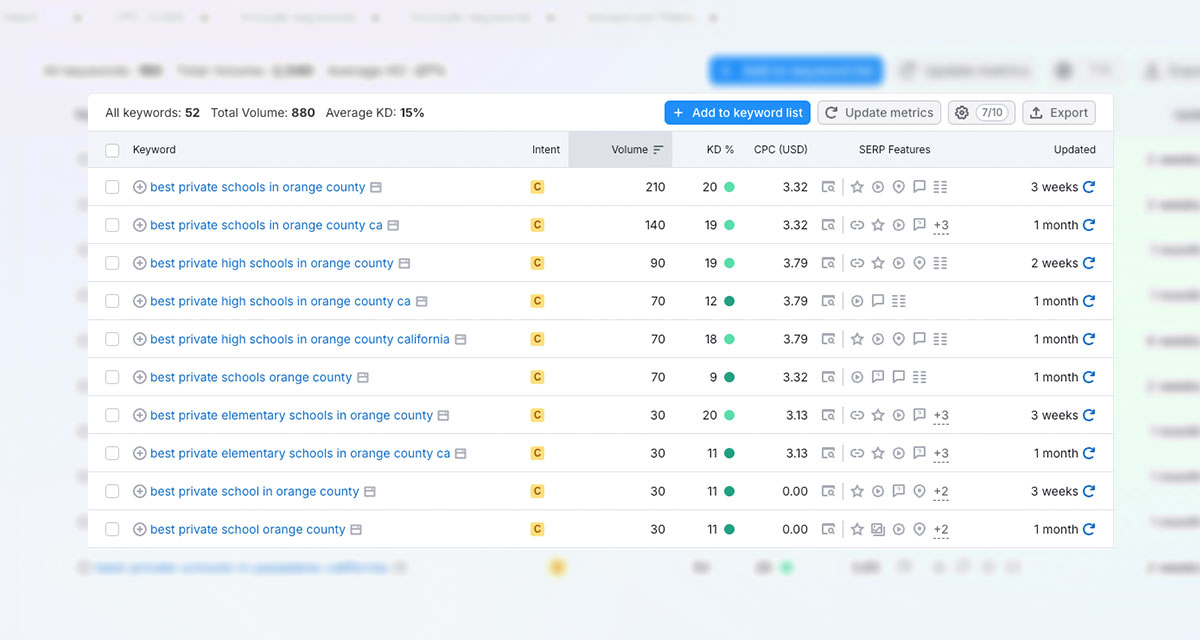
Most families choose a school within a commutable distance, so the searches that matter are local: "private schools near me", "independent prep school [town]", "girls' school [area]". Winning them depends on three things.
- A complete Google Business Profile.
Check that the name, address, phone number, website, opening hours, and photos are correct. Choose an accurate primary category, and review any edits Google suggests, since it can update your profile from other sources. - Pages built around what families search for.
Give each stage, program, boarding option, and entry point its own substantial page. Don't create thin near-duplicate pages for every nearby town. They rarely rank and can drag the rest of the site down. - Technical basics.
Fast mobile load times, descriptive page titles and meta descriptions, one clear H1 per page, and descriptive image alt text. Use Google Search Console and PageSpeed Insights to find what's holding pages back.
6. Get your private school found in AI search
A growing share of parents now start with a question to ChatGPT, Gemini, Perplexity, or Google's AI Overviews and AI Mode as their first step in finding a private school. For example, "What are the best independent schools near Guildford for a sporty child?" These tools summarise what they can find and trust about your school, and they won't always get it right.
To improve how AI tools describe you:
- Search for yourself.
Ask the main AI tools the questions your families ask, and note what's wrong, missing or out of date. - Publish clear facts.
State fees, age range, curriculum, entry points, class sizes and results plainly on your site, in text rather than only in PDFs or images. - Answer questions directly.
FAQ sections and pages that answer one question well are easy for AI tools to quote. - Keep third-party profiles consistent.
Directory listings, inspection reports, and school guides feed AI answers too. Conflicting fees or dates across them undermine trust. - Add structured data.
Organization and School schema help search engines and AI tools understand who you are.
School marketers GEO guideInstagram SEO
7. Create content that helps families decide
Most school blogs are news feeds for current parents: match reports, trip photos, prize days. That content has its place, but it doesn't help a prospective family decide.
Decision-stage content answers the questions families have before they'll book a visit:
- "How do we choose between a prep school and staying in the state system?"
- "What does a typical day look like in Reception?"
- "How does your bursary process work?"
- "What happens if my child needs extra learning support?"
- "How do you prepare pupils for the next stage?"
Show as well as tell. Short videos of real lessons, teachers explaining how they teach, and pupils describing what they love do more than polished promotional films. Film on a phone if you need to; authenticity beats production value.
Then reuse each piece across channels. One teacher interview can become a web page, three social clips, an email, and an open-event talking point.
Inbound Marketing for Private Schools
8. Point paid advertising at specific enrollment gaps
Paid advertising works best when each campaign has one job. "Raise awareness of the school" is hard to measure and easy to waste money on. "Fill the remaining places in Year 3" or "Get 60 families to the October open morning" gives the campaign a clear target.
- Search ads - reach families who are already looking. Bid on local school searches, your own school name (so competitors can't take the click), and program-specific terms.
- Social and video ads - on Meta, TikTok, and YouTube, reach families earlier, before they're actively searching. They work well for open events and for building familiarity in new catchment areas.
- Remarketing - reminds families who visited key pages, such as fees or admissions, but didn't inquire.
Send every ad to a matching landing page, not your homepage. An ad about the open morning should land on a page where you can book the open morning, and nothing else.
Measure campaigns on inquiries, tour bookings, and enrollments, not clicks. A cheap click from the wrong family is expensive.
Having Amplify with us means that our small marketing team can better utilize the limited budgets we have and get the most out of our marketing investment.
Sally Lewis, Head of Marketing and Communications
St George's British International Schools
9. Respond fast and nurture every inquiry
The most expensive moment in a private school's marketing is the one right after a family inquires. You've paid to earn their attention. If nobody replies for three days, many will have booked a tour elsewhere.
- Set a response standard and own it.
Aim to reply personally within one working day, ideally the same day. Decide who responds, who covers holidays, and what happens to inquiries that arrive on a Friday evening. - Make the first reply useful.
Address the family by name, reference their child's age or entry year, answer their question, and offer one clear next step, such as a tour date. - Nurture with a sequence, not a newsletter.
Families who aren't ready to visit need a short series of emails over the following weeks, each answering the next question they're likely to have:- Welcome, and the next open event
- What a day looks like at their child's stage
- A parent or pupil story
- Fees, bursaries and what's included
- How admissions works, with key dates
- A personal note from a named admissions contact
Segment by entry year and program where you can. A Nursery parent and a Sixth Form applicant need very different messages.
10. Put reviews, referrals and ambassadors to work
Parents trust other parents more than any prospectus. Your job is to make those voices easier to find and hear.
Know the Google reviews situation.
Since April 2025, Google has removed and disabled reviews for Business Profiles whose primary category is a general education school serving ages 6 to 18. If that applies to you, don't switch to an inaccurate category to get them back. Put your effort into the channels below instead.
Keep third-party profiles current.
Families still read school guides and review sites, such as Niche, GreatSchools and Private School Review in the US, or The Good Schools Guide and inspection reports in the UK. Check your listings for accurate fees, dates and photos, and that they link to your site.
Collect testimonials properly.
Short video or written testimonials from parents and pupils, collected with written consent, can live on your admissions, fees and visit pages. Put them next to the concern they answer, not on a single testimonials page nobody visits.
Start a parent ambassador program.
Recruit a handful of enthusiastic parents across year groups. Invite them to open events, give them a few talking points, and ask whether prospective families can contact them directly. Hearing "we were nervous about that too" from a real parent resolves doubts no brochure can.
Encourage referrals.
Ask happy families at natural high points, such as after a successful first term or a school event. If you offer incentives, check they sit comfortably with your governance and any applicable rules.
11. Treat retention as a marketing channel
Keeping a family is far cheaper than recruiting a new one, and every family who leaves mid-journey is a place you have to fill again. Retention also feeds recruitment: current parents are your ambassadors, your reviewers and your referral source.
Plan communication for current families as deliberately as for prospects:
- Mark the moments when families decide whether to stay, such as the move between key stages or into Sixth Form, and market the next stage to them before competitors do.
- Share evidence of progress through the year, not only at report time.
- Listen early. A short annual survey, and a proper exit conversation with every family who leaves, will tell you what to fix.
- Make re-enrollment feel like a welcome, not an invoice.
A strong retention rate is also a claim you can use with prospective families. It tells them other parents think you're worth staying for.

12. Measure what leads to enrollment
Traffic, likes and email open rates are useful diagnostics, but they aren't results. The only numbers that ultimately matter are inquiries, tours, applications and enrollments, and the cost of each.
Track each stage of the journey and the conversion between them:
|
Stage |
What to measure |
|---|---|
|
Awareness |
Local search visibility, branded searches, new website visitors |
|
Interest |
Prospectus requests, inquiry form submissions, phone calls |
|
Consideration |
Open event bookings and attendance, private tours |
|
Application |
Applications started and completed |
|
Enrollment |
Offers accepted, deposits paid, cost per enrollment by channel |
|
Retention |
Re-enrollment rate, referrals from current families |
In Google Analytics 4, set up form submissions, tour bookings and prospectus downloads as key events, and test that each one fires correctly. Record the source of every inquiry in your admissions system so you can see which channels produce families who actually enroll, not just families who click.
Review the numbers monthly during the admissions season and do a full review before each budget cycle. Move money toward the channels producing enrollments, and away from those producing only traffic.
Private school marketing checklist
✅ Enrollment targets set by grade, program and intake
✅ Interviews done with recent joiners and families who chose elsewhere
✅ Two or three outcomes chosen as your positioning, each with proof
✅ Fees, admissions steps and visit booking easy to find on mobile
✅ Google Business Profile complete, with an accurate category
✅ AI tools checked for how they describe your school
✅ Content that answers prospective families' questions, not just school news
✅ Each paid campaign tied to one enrollment gap and its own landing page
✅ Same-day response standard and an email nurture sequence in place
✅ Third-party profiles, testimonials, and a parent ambassador program active
✅ Retention moments mapped and planned for
✅ Inquiries, tours, applications, and enrollments tracked by source
Frequently Asked Questions
| What is the most effective marketing strategy for a private school? |
|---|
|
There isn't a single one, but the biggest gains usually come from fixing what happens after a family inquires: fast responses, easy tour booking, and useful follow-up. Better advertising can't make up for inquiries that go cold. |
| How much should a private school spend on marketing? |
|
Work it out from your enrollment targets rather than a percentage of turnover. Estimate how many inquiries you need, what each typically costs by channel, and set the budget from there. |
| How do private schools increase enrollment quickly? |
|
In the short term, target paid search at families already looking, promote a specific open event, and make sure every inquiry gets a same-day personal reply. Longer-term growth comes from positioning, content, and retention. |
| Do Google reviews still matter for schools? |
|
For most schools serving ages 6 to 18, Google no longer shows reviews on their Business Profile. Testimonials on your own site, third-party school guides and parent ambassadors now do that job. |
| How do I get my school to appear in ChatGPT and AI search? |
|
Publish clear, factual information about fees, curriculum and admissions in plain text on your website. Answer common questions directly, and keep your details consistent across directories and guides. |
| Should a private school use a marketing agency? |
|
It depends on your team's time and skills. Many schools keep strategy and storytelling in-house and bring in specialists for SEO, paid advertising or extra capacity at peak times. |
Putting it into practice
You don't need to do all 12 at once. Start with the ones closest to enrollment: response times, your website's admissions pages, and measurement. Then work outward to positioning, content, and awareness.
The schools that grow steadily aren't necessarily the loudest or the biggest spenders. They know exactly which families they want, prove what they promise, and make every step from first search to first day feel easy.
Looking for
Marketing Support
Whether you need a strategic sounding board, or specialist advertising support to boost
your admissions inquiries, reach to our friendly team for expert, no-obligation advice.
 |
Author: Gretlin Aumre, Director of Services Gretlin has spent the last 15 years in marketing, both agency and client-side, and has a rich understanding of content marketing, SEO, and digital advertising. With significant experience in the education sector, Gretlin joined Amplify in May 2024 as Director of Services. She now supports schools worldwide in amplifying their enrollment strategy. |
Discover more

Surviving School Marketing Budget Season

SEO for Schools: 2026 Guide to Google & AI Search Rankings

GEO: The School Marketer's Guide to AI Search Optimization

Effective Strategies For Private School Marketing

Your School's Instagram Shows Up on Google. Is It Ready to Be Found?

Are The Recent UK Private School Closures Due To VAT?