
Last updated: Monday 28th September 2026
Do Schools Still
Need To Prioritize SEO?
Yes, but the goal has changed. SEO is still one of the most cost-effective ways to reach families who are actively searching for a school, and Google still handles the large majority of US searches (StatCounter).
What's different is what families see first. Paid ads take up more space, and AI Overviews now sit above many results. When an AI summary appears, people click through to websites about half as often (Pew Research Center).
So ranking is no longer enough on its own. Your school needs to rank and be the source AI tools trust and cite. This guide covers both, step by step.
WHAT THIS ARTICLE COVERS:
SEO Tips and Best Practices
For Private Schools
Intrigued? Not sure where to start? We've got you covered. We've put together the top best practices and strategies you can use on your school website to improve search engine rankings and online visiblity. Let's dive in...

Step 1.
Keyword Research
Keyword research is the foundational step in any successful SEO strategy. It involves identifying the words and phrases potential students and parents use when searching for schools.
Start by brainstorming terms related to your school's offerings, such as "private high school in [city]" or "STEM programs for middle school." It might be helpful to think about:
- Location-based Terms
Think about what people would search for when thinking of schools in a commutable distance to you. For instance, "private schools in [city name]". - Specific Programs or USPs
These search terms would highlight USPs of your school. Examples could include International Baccalaureate program, Advanced Placement program, or sports scholarships etc., - Common Queries
Address some of the frequently asked questions parents might have about educational options and outcomes. - Include Both Broad and Niche queries
Focus on both broad and specific long-tail keywords. This will help you capture both high search volume terms as well as bottom-of-funnel and very specific queries effectively.
|
|
Keyword research tools
Once you have a list, the magic really happens when you start parsing it through keyword research tools. Utilizing tools like Google's Keyword Planner or SEMrush will help you uncover wich keywords have the highest search volume and cross reference that against how competitive each term is (in other words, how hard it would be to rank highly for).
Depending on what you use, you may also discover some new keyword ideas as part of this process. You can use free and/or paid tools to assist in your keyword discovery - here are some of the best out there:
- Moz Keyword Explorer - An excellent all-around SEO keyword research tool that's free to use
- Google Keyword Planner - Perfect for researching paid keywords
- Semrush or AHREF's - More advanced insights for SEO professionals.
- RyRob Free Keyword Research Tool - Super simple to use, and free!
Forming a keyword strategy
The next stage involves taking all the newly found data you've uncovered and giving it structure, so that you can make informed decisions on your SEO strategy.
Putting aside the more complex aspects of SEO (like evaluating backlinks), a basic approach that will work for most school marketers who are starting out, is to:
- group your keywords into clusters of similar content and keywords
- Then sort these clusters by potential traffic volume
- And finally, review how competitive they are (often referred to as keyword difficulty)
This will give you a list of 'low-hanging fruit' terms that will be easiest to target with maximum traffic potential.

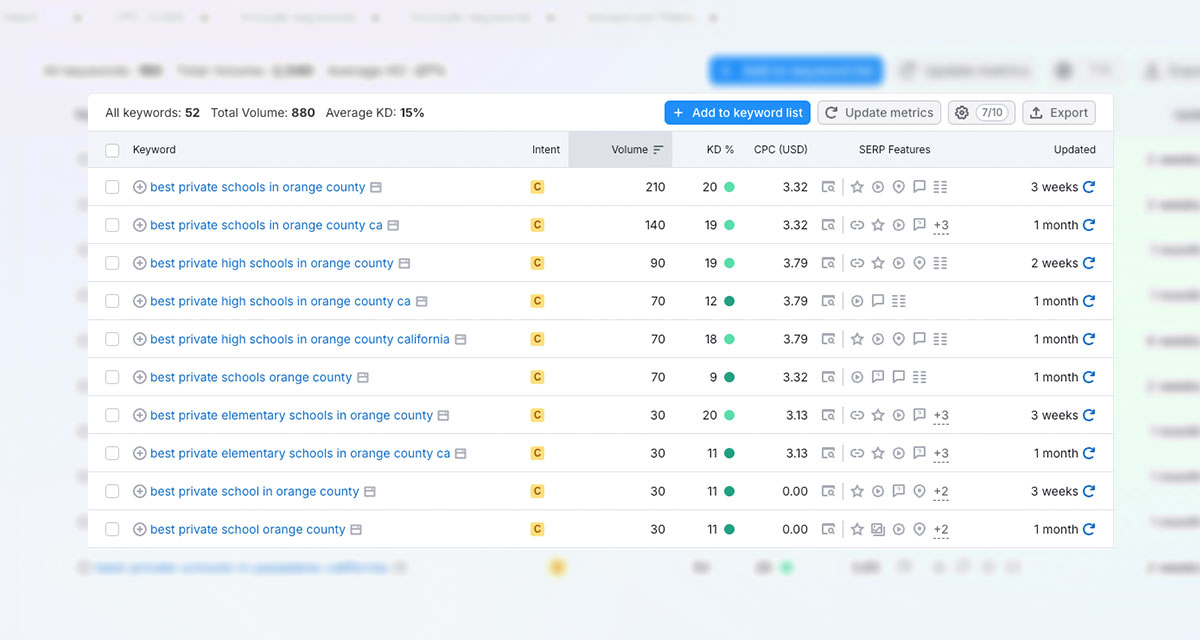
It's really important to remember that search intent should also play a BIG part in deciding which keywords to target. In the example above, there are a couple of things to note:
- It's highly likely that since the user is searching for 'best schools' (plural) in many cases, they may be specifically looking for comparison pages from impartial sources like Niche.com. In instances like this you may be better off considering PPC advertising.
- Don't be tempted to broaden your target keywords geography just for the sake of higher volumes. Consider what the user really wants and how far they are willing to commute each day rather than chasing after higher potential traffic numbers.
Optimizing for Branded vs Unbranded Keywords
When conducting keyword research - it's just as important to consider terms that include your school name (branded terms). After all if a user already knows about your school because you're local of through word of mouth and are willing to search for you, it means they've already got a higher intent to take action.
Find out which branded term(s) will generate the most traffic for you and make sure to target those as part of your strategy. It's most common to optimize your homepage with the primary branded keyword.
Step 2.
Content Creation & Optimization
You've identified some great keywords to target - now what? The real work begins with creating high-quality, relevant content for your target audience.
Create Quality Content
Creating relevant, engaging, and informative content helps attract visitors and keep them on your site longer. Your content should address common questions and showcase your school's unique offerings. Consider developing:
- Blog articles on educational topics.
- Articles about what's taking place in the school
- Videos that highlight your school's unique selling points and extracurricular activities
- Program descriptions
- Student and parent testimonials
Ensure your content includes the keywords identified in your research, naturally woven into the narrative, to improve search visibility without appearing forced. As part of your production process, don't be afraid to scope out your competition so you can ensure your copy is one step ahead.
Leveraging "Shoulder Niches" in Your SEO Strategy
Effective education SEO hinges on the creation of engaging, high-quality content. However, what approach should you take if your niche is perceived as less exciting? Crafting compelling content about education can present challenges.
This is where "shoulder niches" come in: topics your families already care about, where your school has real expertise to add. For US private schools, strong candidates include:
- School choice funding. Explain how education savings accounts (ESAs), vouchers or tax-credit scholarships work in your state, and whether families can use them at your school.
- Phones and screen time. As more districts and states restrict phones during the school day, explain your own policy and the thinking behind it.
- AI in the classroom. Show how your teachers are approaching AI tools, from academic integrity to digital literacy.
- College admissions. Write about testing policies, course rigor, and how your counseling program supports applications.
- Kindergarten readiness. Cover what "ready" really means and the questions parents weigh when deciding when to start school.
Each post earns visibility on searches families are already making, then links naturally to the admissions, program or open house pages you actually want to rank.
Step 3.
On-page Optimization
On-page optimization involves refining what's on your individual web pages, so that they rank higher and earn more relevant traffic.
Once you have compelling content at the ready, it goes without saying that the terms need to feature directly in the text on your webpage but, this process also includes optimizing title tags, meta descriptions, headers, and images with targeted keywords. Let's dive in.
Meta titles & descriptions
Meta title's and descriptions are not visible on the webpage itself, but are what search engines show a preview of in their search engine results pages. Altering these headings and descriptions won't directly influence your SERP position. However, they've been proven to positively influence click-through rates when keywords match search queries. As shown in the example below, the matching text in the users search query is emboldened in the meta description.

When writing your meta title's aim for between 50-60 characters, and for descriptions aim for 150-160 characters. This is because anything over that will likely be cut short. Google and other search engines do however change these limits without notice.
Use Headings and Titles Appropriately
Heading tags are an important indicator of what your web page is about, to you users as well as to search engines. Whilst comprehensive and reader friendly content is still the most important ranking factor - using well structured headings that include your keyword focus is important to help search engines understand your page.
"When it comes to text on a page, a heading is a really strong signal telling us this part of the page is about this topic"
John Mueller - Google Search Advocate
Headings don't just alter the styling of your webpage, they have back-end code that looks like this:
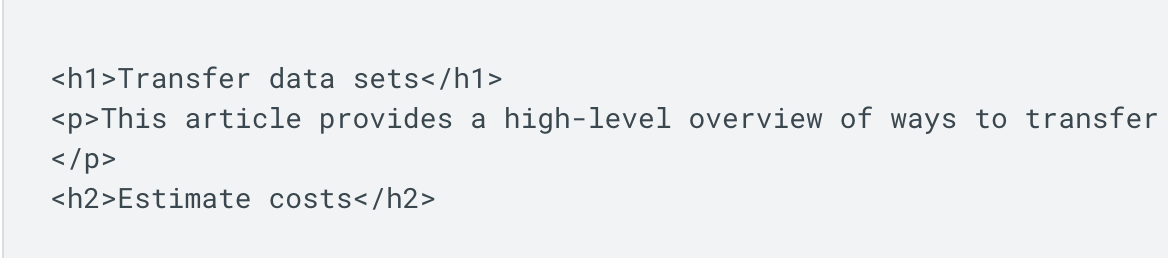
It's advisable to use one unique < h1 > tag on any page of your site, and to use heading tags in order (for example don't skip from a heading 2 tag, to a heading 6 tag). If you're finding that the formatting doesn't fit your needs by using your heading tags in the appropriate order then speak to your web development agency who will be able to help resolve that.
Body content optimization
Sprinkling keywords into your page content is known as 'baking-in' to SEOs. But it's easy to get carried away and stuff keywords into your text. Whilst baking-in isn't a dark art, you should be careful not to cram keywords into your text in an unnatural way as you could be penalised for this.
For optimum content use these handy prompts:
- Are you writing enough? Compare your page with those already ranking highly for your target keyword. Do you cover every topic they do, and more? Is any claim missing a source? Make sure your content is comprehensive enough to answer every question your readers might have.
- Don't shy away from AI. AI writing tools aren't in a position to replace talented humans (yet). But tools like perplexity.ai make incredible resources to help spark new ideas, find suitable sources and outline page content. In other words, they're fantastic at speeding up the writing process and getting you to 'draft 1' faster than you could alone. Just be sure to proof everything carefully!
- State the obvious. Some users won't know what academic abbreviations mean. Never assume knowledge with your readers, and try to keep language easy to digest. Using tools like Grammarly or plugins like Yoast (if you're on a Wordpress website) can help you understand your Flesch readability score. Aim for 60-70 in terms of readability score, unless the page is a very niche topic.
- Include a variety of formats. Where it's appropriate, help users understand your school and your web content better by supplimenting it with images, quotations, videos and attachments.
- Understand your users intent. If all the other pages ranking higher in search results for a keyword are blog articles, don't try and rank for that term using a sales page. Understand whether your user is just gathering data, or if they're further down their decision making funnel, and ready to book a tour. That will help guide you in providing appropriate content for the page. Remember pages with better engagement also see rank higher.
- Use Structured Markup where relevant. Structured data (or Markup) helps search engines and AI tools understand your content, and can earn rich results for things like events and reviews. Make sure your content utilizes structured data using standardized schema.
If you are using a Wordpress CMS site, there are several plugins like Yoast SEO or RankMath that will help you understand how well your page content is optimized.
Image alt text
Whilst it's getting smarter every day, Google and other search engines don't automatically understand what content is included in your imagery. Ensure image (except for decorative imagery) has descriptive alt text that helps search engines understand what it contains and include your keywords where appropriate.
If you're using the AMAIS content managment system, it's as simple as double clicking your image and filling in this field:

This not only helps spiders understand a context for your webpage, you may also find your images ranking in image searches. SEO aside, this is something schools should be doing anyway as improves accessibility, by allowing users who need screen readers to understand the content of your images too.
Internal Linking
Strategically placing internal links within your content encourages visitors to explore related topics and discover more about your school's offerings, increasing time spent on your site. For instance, when discussing the school's STEM programs, include links to individual pages detailing specific courses or success stories related to that program.
"Internal linking is super critical for SEO. It's one of the biggest things you can do on a website to guide Google and visitors to the pages that you think are important."
John Mueller - Google Search Advocate
Moreover, internal links assist in guiding search engines as they crawl your website, improving the overall structure and helping important pages rank better in search engine results. Having a link ecosystem around specific keyword clusters helps to build topical authority. Be mindful to use anchor text for relevant searches, as this not only aids in context but also boosts search engine understanding of your site's content.

Step 4.
Optimize for Local Search
For schools, local SEO is crucial, and reviews are a big part of it. In BrightLocal's 2026 survey of US consumers, 97% said they read reviews for local businesses. 31% will only use a business rated 4.5 stars or higher, up from 17% a year earlier, and 74% look for reviews written in the last three months. That makes your school's local presence, and a steady flow of fresh parent reviews, well worth your attention.
Your first steps to ensure visibility and that Google ranks you for local searches should include:
- Claim and optimize your Google Business Profile
- Ensure consistent NAP (Name, Address, Phone) information across all online listings including your social accounts and review sites
- Encourage reviews from parents and students
- Weave location-specific content throughout your site, in line with your keyword research (hint, you can be a little subtler in your approach than the Thai restaurant above 😉)
- Google Business Profile now allows you to directly update your social profiles so make sure those are up to date.
Step 5.
Build Quality Backlinks
Backlinks (also referred to as inbound links) from other websites, play a significant role in education SEO. They act as endorsements of your site's content, signaling to search engines that your school is reputable and authoritative as well as driving extra traffic.
To build quality backlinks, collaborate with other reputable education focussed websites. These could be:
- Local businesses and community organizations
- Educational blogs
- Popular review sites
- Alumni networks
- Other education institutions (e.g. Feeder schools)
Consider guest blogging on education-focused sites or hosting events that garner media coverage. Each backlink from a reputable website strengthens your school's domain authority, improving your search engine ranking.

Step 6.
Improve Technical SEO & Run an Audit on Your Website
Technical SEO focuses on optimizing the backend of your website to improve search engine crawling and indexing. Address basic technical aspects to improve your site's performance:
- Mobile friendliness: Ensure your site is mobile-friendly. Google announced mobile-first crawling and indexing of websites in 2016 and has fully rolled it outglobally since 2023. That's why it goes without saying that your site must be accessible on mobiles and tablets as a priority.
- Webpage performance: Improve page load speeds. Experience signals on your website, including 'core web vitals' are a ranking factor. This means that assuming you have equally strong content as your competing schools, but your site is slower to load and less user friendly, you will receive less organic traffic. Use tools like Pagespeed Insights or Google Search Console's Page Expereince and Core web vitals reports to understand where you need to improve.
- Sitemaps: Create an XML sitemap and to request a re-crawl it whenever major changes take place in Google search console to ensure Google ranks you promptly.
- User-Friendly Navigation: Ensure your website's navigation and structure are intuitive and user friendly, anUse internal linking to connect related pages
- URL Structure: Are your webpage urls user friendly? The structure of your sites urls should be logical with a clear website heirarchy that mirrors your navigation. Use target keywords in your urls, but keep the lenght as succinct as possible.
- Website Security: Implementing an SSL certificate ensures your site is secure, again contributing to Google's 'experience' factors - as well as showing your users you take data security seriously.
These technical improvements help search engines crawl and understand your site better. The best way to understand how your site is doing technically is to run a comprehensive technical audit or get a specialist SEO agency to complete this for you.
Step 7.
Optimize for AI Search
and AI Overviews
Families no longer research schools only through the ten blue links. They ask Google's AI Overviews and AI Mode, ChatGPT, and Perplexity questions like "What are the best private schools near me with strong STEM programs?", and they get a summarized answer before they see a single website. According to BrightLocal's 2026 survey, 45% of US consumers now use AI tools for local recommendations, up from just 6% a year earlier (BrightLocal).
The payoff for getting this right is clear. Ahrefs found that AI Overviews cut clicks to the top-ranking result by 58% (Ahrefs). If your school is the source the AI cites, you keep your visibility. If it isn't, even a #1 ranking loses much of its value. Optimizing for AI search is often called GEO (generative engine optimization). Here's where to start:
1. Answer real parent questions directly.
Ask your admissions team what families ask on tours and calls. Then use those questions as headings and answer each one in the first sentence or two beneath it. For example:
- "What's the difference between a private school and a charter school?"
- "Can I use an ESA to pay private school tuition in [state]?"
- "What's the average class size at [School Name]?"
- "What should I ask on a private school tour?"
2. Make your key facts unmistakable.
AI tools cross-check sources before they cite one. Keep tuition ranges, grades served, enrollment deadlines, accreditation, address, and phone number identical on your website, your Google Business Profile, Niche, Private School Review, and your social profiles.
3. Earn mentions beyond your own website.
AI answers lean heavily on third-party sources. Local news coverage, community partnerships, staff quoted as experts, and active parent reviews all shape how AI tools describe your school. Your public social profiles count too (how your Instagram shows up on Google).
4. Keep content fresh and dated.
Show a "last updated" date on key pages. Refresh admissions, tuition, and open house content every term, not every few years.
5. Add structured data.
Use School or EducationalOrganization schema on your homepage and Event schema for open houses. This gives AI systems clean, machine-readable facts to work from.
6. Track your AI visibility.
In GA4, watch referral traffic from chatgpt.com, perplexity.ai, and similar sources. Once a month, ask the major AI tools the questions your families ask and note whether your school appears. Specialist monitoring tools can automate this as you scale.
For the full playbook, read GEO: The School Marketer's Guide to AI Search Optimization. To use AI in your own content workflow, see AI for School Marketing: How the Smartest School Marketers Are Leveraging the AI Revolution.
Step 8.
Performance Measurement
SEO isn't a one-time activity. It's an ongoing effort and needs continued attention for success. Besides that, you'll most likely find your efforts don't get you to position 1 for your desired keywords in the first attempt.
With that in mind, for best results, setup reports that measure your organic traffic efforts and iterate, iterate, iterate. Google Search Consolse and GA4 data can easily be fed into free tools like Looker Studio to create comprehensive reports on how your key pages are doing. Look at both clicks as well as impressions. A sudden jump in impressions could indicate you've secured a featured snippet, or are getting close to position 1 in Google. So don't be disheartened if you don't see immediate traffic results!
If you are using professional SEO tools (see Step 1 for our recommendations), you can also automate reports to send you updates at a regular cadence.
Step 9.
The Importance of a User-Friendly Interface
The user experience (UX) and user interface (UI) of your school website is a cornerstone of SEO. When prospective students and parents visit your site, their ability to quickly find relevant information—such as admissions details, academic programs, or contact options, directly influences how long they stay on your website and your engagement metrics.
A well-designed interface includes clear navigation menus, logical page hierarchies, readable fonts, and fast-loading pages. These elements not only make your website more accessible for all users—including those with disabilities—but also reduce bounce rates and encourage deeper exploration of your school's offerings. Ultimately, prioritizing a user-friendly interface not only helps your audience but also strengthens your SEO, making it easier for your school to stand out in competitive search results.
Frequently Asked Questions
| What is SEO For Schools? |
|---|
| SEO for schools is the practice of improving your school website so it appears when families search for schools like yours on Google and in AI search tools. It covers keyword research, content, on-page optimization, local search, backlinks, and technical performance. |
| How long does SEO take to work for a school website? |
| Most schools see early movement within three to six months, with bigger gains over six to twelve months. Local search and technical fixes tend to show results fastest. Competitive terms like "best private schools in [city]" take longer. |
| Do AI Overviews mean SEO is dead for schools? |
| No. AI Overviews draw on the same well-ranked, well-structured pages that traditional SEO produces. What's changed is that ranking alone captures fewer clicks, so schools also need to be the source AI tools cite. |
| What's the difference between SEO and GEO? |
| SEO helps your pages rank in search results. GEO (generative engine optimization) helps your school get cited in AI-generated answers from tools like Google AI Overviews and ChatGPT. The two overlap heavily, and strong SEO is the foundation for GEO. Learn more in our GEO guide for schools. |
| How can my school get cited in AI Overviews or ChatGPT? |
| Answer common parent questions clearly on your site, keep your school's facts consistent everywhere they appear online, earn mentions from local media and trusted directories, and keep key pages current. AI tools favor sources that are clear, consistent and corroborated elsewhere. |
| Should private schools invest in SEO or paid search? |
|
Ideally both. Paid search delivers immediate visibility for high-intent terms, especially around enrollment deadlines and open houses. SEO builds long-term visibility that doesn't stop when your budget does. |
| Which keywords should a private school target first? |
| Start with your branded terms and high-intent local searches, such as "private school in [city]" or "[grade level] private school near me." Then add program-specific terms that highlight what makes you different, such as IB, AP, STEM or boarding. |
| How do I know if AI search is sending families to my website? |
| Check GA4 for referral traffic from AI tools like ChatGPT and Perplexity, and watch for growth in branded search in Google Search Console. You can also test the questions families ask in each major AI tool each month and track whether your school is mentioned. |
Looking for
SEO Support?
Are you looking for search engine marketing support? We're here to help.
Get the most out of your website and its content with expert advice.
 |
Author: Gretlin Aumre, Director of Services Gretlin has spent the last 15 years in marketing, both agency and client-side, and has a rich understanding of content marketing, SEO, and digital advertising. With significant experience in the education sector, Gretlin joined Amplify in May 2024 as Director of Services. She now supports schools worldwide in amplifying their enrollment strategy. |
Discover more

Are The Recent UK Private School Closures Due To VAT?

Your School's Instagram Shows Up on Google. Is It Ready to Be Found?

GEO: The School Marketer's Guide to AI Search Optimization


How To Choose The Right Marketing Agency For Your School


Surviving School Marketing Budget Season
SEO for Schools: 2026 Guide to Google & AI Search Rankings